Image
Tatiana Reynolds is a Cultural Anthropology and Economics major in the class of 2026 and a featured guest blogger. Tatiana was a student in our human rights seminar course, Memory Bandits, in fall 2025. This seminar introduced students to multiple approaches to why and how to create memory, with a focus on contributing to a project underway at Catawba Trail Farm. Several students will be featured guest bloggers on the Duke Human Rights Blog this month as part of our Student Stories: Memory Bandits Series.
When I walked onto Horton Grove, part of the historic Stagville Plantation, one of the largest plantations in North Carolina, I told my fellow classmates that I had an eerie feeling. I thought about the memories stored in the soil and the trees, the things they had witnessed. Memory Bandits—scholars who dedicate their work to challenging oppressive ideological, political, and social systems through the deliberate recovery of subjugated knowledge, memories, histories, and experiences—tell the story of what the environment has witnessed.
The study of the past for social justice requires deep work and difficult questions. What are the missing narratives of the oppressed? How do we negotiate memorialization when trauma still echoes in these spaces?
I answered these questions by rooting myself in the idea of acknowledging yet overcoming: understanding that the United States has created systems that facilitate barriers to social mobility for people of color, yet they have still found a way to achieve community success.
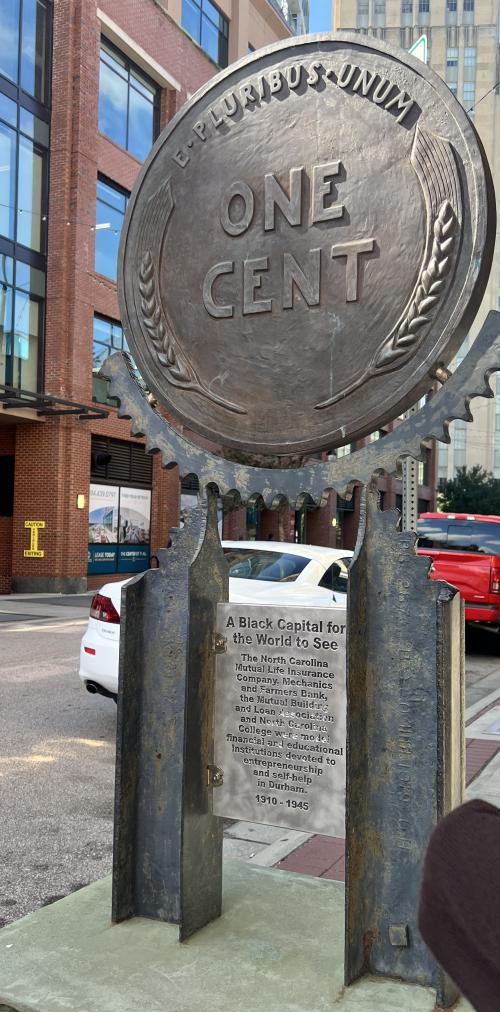
I researched ties between the formerly enslaved Stagville descendants and the Black aspiration that led to achievements like Durham’s Black Wall Street. I learned a lot from the Descendants Council’s Memorial Projects, specifically from
Ricky Hart, the Chairman of the Council Board. Hart’s community involvement includes the Durham Branch NAACP, Durham Committee on the Affairs of Black People, Durham City Human Relations Committee, and serving as Board Chair of Lincoln Community Health Center.
Mr. Hart and I discussed those who fought to become lawyers, doctors, veterans, and more, defying odds, learning, and thriving. “I guarantee you there will be sections, groups, neighborhoods or whatever, if they have to come together to protect their neighborhood for whatever, that's what's going to happen. Those that have been through different things, whether they were law enforcement, military, anyone that has that experience, they're going to call on those people with that experience right to be able to do that.”
I explored examples of that in Durham.
I researched the life of Inez Suitt, a Stagville descendant and member of Delta Sigma Theta Sorority, Incorporated. Delta Sigma Theta Sorority, Incorporated is an international organization of educated women committed to public service. Their primary focus is on the Black community. The sorority has been at the forefront of social action since Jim Crow; for example, they sponsored the bookmobile to enhance access to books in Black communities during segregation.
Suitt became a medical technician at Lincoln Hospital, the first hospital for Black Americans in Durham. Beverly Evans, another Suitt descendant and current Executive Board Member of the Descendants’ Council, was also a member of Delta Sigma Theta Sorority, Incorporated. Evans is a retired educator after thirty-nine years in Newark Public Schools as a former Technology Instructor and Project Coordinator for the Office of Community Relations, demonstrating her commitment to public service.
As a Delta myself, they remind me that the communities we walk amongst today exist because those before us persevered and aspired, despite the origins of their stories and the horrific circumstances they had to overcome. That subjugated knowledge, memory, and historical resilience must be told in order to dismantle the harmful frameworks of prejudice that persist today. Only then, will we be able to work towards a more equitable future.