Image

Kulsoom Rizavi is a Political Science and Computer Science double major in the Class of 2026. Kulsoom is one of our 2025 Human Rights Summer Research Grant winners and a featured guest blogger. Grant winners will be sharing an inside look into their experiences on the Duke Human Rights Blog this summer and fall as part of our Student Stories: Summer Research Series.
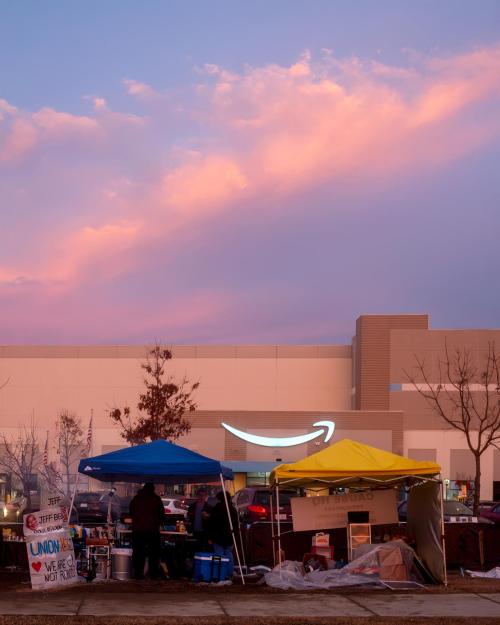
The first time I slept outside an Amazon warehouse was in February 2025. RDU1, the fulfillment center in Garner, North Carolina, was gearing up for a historic union vote. If it passed, it would become the first Amazon warehouse in the South and only the second in the entire country to unionize. “Nobody thought we'd even collect enough cards to be able to call for an election”, I was repeatedly told (according to the National Labor Relations Board rules, a showing of interest supported by at least 30% of employees in a potential bargaining unit is required for a union to even file a petition to hold an election).
The election was eventually lost. 2447 - 829 in Amazon's favor. But I was enamored by the moments that did not make it into the news: the conversations behind closed doors; the flyers and food drives; the exhausted but determined workers; the organizers who knew they were going up against one of the most powerful companies in the world, and showed up anyway. And so, I decided to spend this summer researching the systemic failures that enable corporate actors to evade labor law and documenting on camera what it takes to lead a labor movement in the state with the second lowest union density in the country.
Amazon employs roughly 1.5 million people in the United States. Hundreds of thousands of those workers are inside warehouses, dealing with long hours, high turnover, and serious injuries. In 2021, Amazon employed a third of all warehouse workers in the country but was responsible for over half of the industry’s injuries. Despite the constant churn of new hires, 41% of workers report having been injured on the job.
There appears to be a system in place here that quietly relies on physical burnout, high injury rates, and cheap labor. It’s also a system designed to keep workers from organizing. Amazon spends tens of millions of dollars a year on union-busting consultants (just 0.002% of their annual revenue). What’s more shocking is how effective that spending is. Workers are tracked, surveilled, and sent anti-union texts. Organizers are fired and arrested. New employees are bombarded with “union education” videos during orientation. Entire firms exist just to prevent workers from organizing. When the first Amazon warehouse in Alabama filed for a union election, Amazon fought back so hard the vote had to be redone (twice) because of illegal interference. When the Staten Island warehouse succeeded in unionizing in 2022 under the Amazon Labor Union (ALU), Amazon simply refused to come to the bargaining table. Even now, years later, they still haven’t.
Most consumers have no idea what’s going on inside these warehouses. The Amazon box arrives at their doorstep, and that’s the end of the story. But the real story is what happens before that: who’s lifting the packages, who’s skipping breaks and who’s getting fired for talking to their coworkers about forming a union.
North Carolina is an especially hard place to organize. There’s a long history here of violent pushback, broken contracts, racism, and anti-union laws. Public sector workers in the state are still banned from collective bargaining. Employers aren’t required to recognize unions even if workers vote for them (and so, Amazon can just shut down warehouses if employees vote to unionize as it happened in Quebec). It’s a "right-to-work" state - a misnomer since it means workers have fewer rights, not more.
But labor organizing in the South also has a radical and often-overlooked history. Black sharecroppers in the 1930s organizing for better pay. Textile mill workers in the 1970s striking for safer conditions. The Memphis sanitation workers' strike in 1968, where Dr. Martin Luther King Jr. gave his final speech. These movements were deeply intersectional, fighting not just for wages, but for dignity, racial justice, and survival.
The people I’ve met this summer are the most diverse group I’ve ever filmed. Young workers who just graduated high school, older workers looking to retire, immigrants from all over the world, veterans, college graduates. All of them with different motivations, different politics, different reasons for staying. Holding this kind of coalition together is hard. Everyone comes in with their own expectations and fears. Some are tired and want action now. Others are skeptical, unsure, and afraid of losing their job.
I remember talking to one of the lead organizers during the election campaign. We were discussing the “sunk cost fallacy,” the idea that people keep investing in something, not because it’s working, but because they’ve already poured so much into it. He nodded. “That’s exactly what this has felt like,” he said.
I asked him what keeps him going, then.
“Somebody has to,” he responded.
This summer, I’ve come to understand that labor ties back to everything. The movement is deeply intersectional. It involves everyone and affects everything. And at its core, it's not just about wages or contracts. It’s about dignity and imagination. About ordinary people asking, “What if the world didn’t have to be this way?” and then doing the slow, exhausting, unglamorous work of trying to make it so.
Human Rights Summer Research Grant winners will be sharing an inside look into their experiences on the Duke Human Rights Blog this summer and fall as part of our Student Stories: Summer Research Series. Follow Duke Human Rights Center on social media and sign up for our newsletter to keep up with this series. Look out for part 2 of Kulsoom's research experience this fall!