Image
Hannah Baetge is a Marine Science and Conservation major in the class of 2026 and a featured guest blogger. Hannah was a student in our human rights seminar course, Memory Bandits, in fall 2025. This seminar introduced students to multiple approaches to why and how to create memory, with a focus on contributing to a project underway at Catawba Trail Farm. Several students will be featured guest bloggers on the Duke Human Rights Blog this month as part of our Student Stories: Memory Bandits Series.
In Michel–Rolph Trouillot’s Silencing the Past: Power and the Production of History, he argues that history is not merely a truthful objective record of the past, but rather a unilateral construction of memory – memory that is most often written and controlled by those in positions of power. This perspective has never felt more vivid to me than after interviewing Beverly Evans, a direct descendant of an enslaved family on the Stagville Plantation.
Ms. Evans is a retired educator who worked in the Newark Public School District and participated in NASA’s Teachers in Space Program. She now serves as the Special Events Coordinator for the Stagville Descendants Council. Ms. Evans is a descendant of formerly enslaved Jesse and Margaret Mangum on her maternal side.
Her reflections revealed how the power to shape historical memory continues to determine whose stories are told and whose are silenced. Traditional narratives of African American history, predominantly written by white men, have too often portrayed enslaved people as powerless and dependent, reinforcing “white savior” myths. In contrast, Ms. Evans offered me a perspective that illuminated the extraordinary courage, creativity, and innovation of the enslaved communities. This changed the way I thought about the lives of enslaved people.
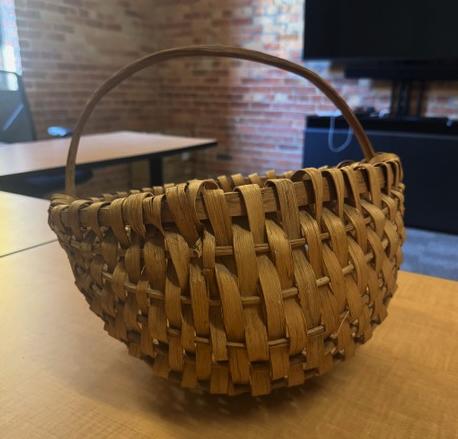
I learned that enslaved women often served as healers and cultural stewards. They gathered and cultivated what they could: raspberry leaves for alleviating pregnancy symptoms, honeysuckle flowers as a substitute for sugar, squash for carving spoons and shaker drums, Creasy plant greens (a variation of cabbage) for crafting nutrient-rich recipes, corn husks for making hot drinks, sweetgrass for braiding poultices, and white oak for weaving baskets and toys.
Thanks to Ms. Evans, I was even lucky enough to hold baskets made by her ancestors. I could literally feel this history in my hands.
That legacy of ingenuity, which preserved both ancestral knowledge and community health, Ms. Evans explained, continues to shape her family today through their resilience, academic excellence, and career paths in science and healthcare.
To me, Ms. Evans’ story challenges the single-narrative histories that fuel racism and sexism today. If we are to dismantle entrenched structures of inequities, we must begin by re-examining how we remember and what we choose to honor – a task that can only be achieved by listening to the voices and sharing stories like Ms. Evans’ that have been silenced for generations.
Over the course of the semester, I’ve tried to contribute to this goal by creating a youth curriculum that centers historically neglected African American and Indigenous voices. This curriculum teaches students about the Catawba Trail Farm through a multidisciplinary approach that merges themes of ecology, conservation, wellbeing, and justice. In a lesson plan inspired by Duke alumna Leslie Niiro’s research paper on historical education strategies, students explore the social and ecological histories of the land through representative memory items, like Ms. Evans’ baskets. Through reflective exercises and a letter-writing activity, students learn to connect their personal identities to the people whom these items once belonged to.

In another lesson plan, I’m drawing from the indigenous philosophies in Robin Wall Kimmerer’s Braiding Sweetgrass and scholarship on the role of art in environmental education. Students study the ecology of the Little River through both scientific observation and artistic drawing. By weaving art and science together, students can gain a deeper biological understanding of the ecosystem and cultivate an emotional relationship with the land – both essential in building lasting environmental stewardship.
With these lesson plans and others I’ve developed in collaboration with Urban Community Agrinomics, I hope to help reconstruct how we think about history, what we choose to honor, and how we engage with the present to build a more equitable future.
Justice lies in truth, however unpleasant it may be, and truth lies in a messy array of conflicting narratives. I’ve learned that we must immerse ourselves within this beautifully chaotic stream of voices simply by listening and welcoming the full breadth of perspectives.
Ms. Evans told me that her history is like rosemary – bittersweet: bitter for the cruelty that her family endured, sweet for the resilience it brings forth. And she’s right, history is like rosemary. Its bitterness confronts us with what has shaped and scarred us. Its sweetness reminds us of what communities have preserved in spite of it. Only by seeking to understand its truths can we gather the strength, depth of perspective, and empathy to carry forward and to help repair not the things that we have broken, but the systemic harms that continue to echo through us.